
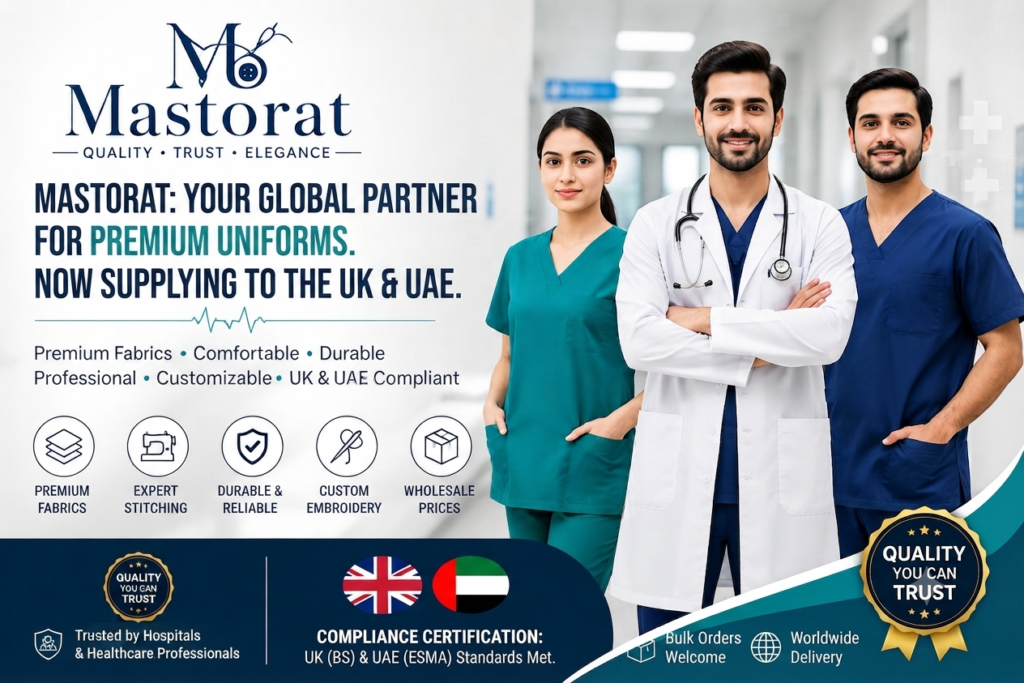
The uniform industry has evolved into one of the most stable and profitable sectors within the global apparel market. Businesses, schools, hospitals, hotels, restaurants, airlines, security companies, construction firms, and corporate organizations all require professionally designed uniforms that reflect their brand identity while ensuring comfort and durability.
Both the United Kingdom and the United Arab Emirates present excellent opportunities for entrepreneurs looking to enter the uniform business. These countries have thriving hospitality industries, expanding healthcare sectors, growing educational institutions, and increasing demand for customized workwear. Unlike fashion apparel, uniforms are purchased consistently throughout the year, making them less vulnerable to seasonal trends and economic fluctuations.
For entrepreneurs planning to establish a uniform business, sourcing quality fabrics and dependable manufacturers is one of the most important decisions. Pakistan has become one of the world’s leading textile manufacturing hubs, supplying premium-quality fabrics and garments to international buyers. Businesses seeking dependable textile sourcing often explore experienced Pakistani clothes wholesale suppliers for competitive pricing and consistent production quality.










Why the Uniform Business Is Growing in the UK and UAE
Uniforms are no longer viewed simply as workplace clothing. They have become an essential branding tool that represents professionalism, trust, and organizational identity. Companies invest heavily in customized uniforms because they help create a consistent customer experience while improving employee confidence.
Several industries continue driving demand:
- Schools and colleges
- Hospitals and clinics
- Hotels and restaurants
- Corporate offices
- Airlines
- Manufacturing companies
- Construction firms
- Security agencies
- Retail chains
- Cleaning companies
- Logistics businesses
The United Kingdom continues expanding its healthcare, education, and hospitality industries, while the UAE remains one of the world’s fastest-growing business destinations. Cities such as Dubai, Abu Dhabi, Sharjah, Birmingham, London, Manchester, and Glasgow regularly see new businesses requiring branded uniforms.
Why Pakistan Is an Ideal Manufacturing Hub
Pakistan is internationally recognized for producing premium cotton fabrics, stitched garments, embroidery, and textile products. The country’s textile infrastructure allows manufacturers to produce both standard uniforms and highly customized corporate apparel at competitive prices.
Business owners often choose Pakistani manufacturers because they offer:
- Competitive wholesale pricing
- High-quality cotton fabrics
- Polyester blends
- Custom embroidery
- Screen printing
- Private labeling
- OEM manufacturing
- Bulk production
- Flexible MOQs
- International shipping
Many apparel retailers already source garments through Pakistani dress wholesale suppliers in the United Arab Emirates before expanding into specialized uniform manufacturing.
Choosing Your Uniform Business Model
Before investing money, determine which business model fits your budget and long-term goals.
Uniform Manufacturer
Manufacturers control production, quality, and customization. Although startup costs are higher, profit margins are usually the strongest.
Uniform Wholesaler
Wholesalers purchase uniforms in bulk from manufacturers and supply retailers, schools, hospitals, and businesses.
Many wholesalers begin by partnering with Pakistani dress wholesale suppliers before establishing their own production facilities.
Uniform Retailer
Retail businesses sell uniforms directly to customers through physical stores, websites, or marketplaces.
Retailers generally require lower investment than manufacturers while benefiting from flexible inventory management.
Private Label Uniform Brand
Private labeling allows entrepreneurs to create their own branded uniform collection while outsourcing manufacturing to experienced factories.
This model is growing rapidly because businesses can focus on branding, sales, and customer service rather than managing production.
Understanding Your Target Customers
One of the biggest mistakes new entrepreneurs make is trying to serve every market. Instead, focus on a niche during your first year.
Potential customer segments include:
Educational Institutions
Schools require uniforms every academic year, creating recurring business opportunities. Many institutions also purchase sports uniforms, winter sweaters, laboratory coats, and graduation apparel.
Healthcare Industry
Doctors, nurses, pharmacists, laboratory staff, dentists, and medical technicians require specialized uniforms made from durable, easy-to-clean fabrics.
Hospitality Industry
Hotels, restaurants, cafés, resorts, and catering businesses require elegant uniforms for receptionists, chefs, housekeeping staff, waiters, and management teams.
Corporate Businesses
Large organizations frequently order shirts, trousers, blazers, jackets, ties, scarves, and branded accessories featuring embroidered company logos.
Industrial Workwear
Factories and construction companies require safety-focused uniforms designed with durability and compliance in mind.
Market Research Before You Launch
Never purchase inventory without researching your local market.
Start by identifying:
- Existing competitors
- Average pricing
- Popular fabric choices
- Customer complaints
- Delivery expectations
- Customization demand
- Bulk order opportunities
- Seasonal purchasing trends
Study businesses within your city and identify industries with consistent uniform requirements. This information helps you position your business more effectively.
Entrepreneurs already involved in ethnic fashion often diversify after working with Pakistani dress wholesale online suppliers, allowing them to leverage existing supplier relationships.
Products You Can Sell
A successful uniform business doesn’t need to focus on one product category.
Instead, build a diversified portfolio including:
- School uniforms
- Medical scrubs
- Nursing uniforms
- Chef jackets
- Waiter uniforms
- Hotel housekeeping uniforms
- Corporate shirts
- Polo shirts
- Blazers
- Industrial coveralls
- Security uniforms
- Reflective safety jackets
- Laboratory coats
- Work trousers
- Aprons
- Caps
- Safety vests
- Winter jackets
- High-visibility clothing
Offering multiple product categories increases average order value while improving customer retention.
Building Relationships with Reliable Suppliers
Choosing the right supplier is often the difference between long-term success and constant customer complaints.
Evaluate suppliers based on:
- Manufacturing capacity
- Quality consistency
- Lead times
- Fabric sourcing
- Sample availability
- Export experience
- Communication
- Certifications
- Packaging options
- Private label services
Businesses looking for premium South Asian apparel sourcing frequently compare suppliers offering Pakistani designer suits alongside commercial garment manufacturing, as this demonstrates strong tailoring capabilities.
Why Quality Matters More Than Price
Many new businesses focus solely on finding the cheapest supplier. This approach often leads to poor stitching, inconsistent sizing, delayed deliveries, and dissatisfied customers.
High-quality uniforms deliver several advantages:
- Better durability
- Improved customer satisfaction
- Stronger brand reputation
- Repeat corporate contracts
- Lower product returns
- Higher profit margins
In competitive markets like the UK and UAE, reputation becomes your greatest marketing asset. Businesses are far more likely to reorder from suppliers who consistently deliver premium-quality uniforms on time.
Planning for Long-Term Growth
The most successful uniform businesses don’t think only about today’s sales—they build systems that support long-term expansion.
Invest early in:
- Strong supplier relationships
- Professional branding
- Inventory management
- Customer service
- Digital marketing
- Product quality
- Corporate partnerships
- Scalable operations
Starting with a clear strategy positions your business to secure recurring contracts from schools, healthcare providers, hospitality groups, and corporate organizations. In the following section, we’ll explore how to create a detailed business plan, estimate startup costs, conduct competitor analysis, and develop a profitable pricing strategy for launching a uniform business in both the UK and UAE.
Create a Business Plan for Your Uniform Business
A well-structured business plan is the foundation of a successful uniform business. Whether you’re targeting schools in the UK or hospitality companies in the UAE, having a roadmap helps you manage finances, attract clients, and scale efficiently.
Your business plan should answer key questions such as:
- What type of uniforms will you specialize in?
- Who are your target customers?
- Where will your products be manufactured?
- How will you market your business?
- What pricing strategy will you use?
- How much startup capital do you need?
- What are your short-term and long-term goals?
Investors and banks also expect to see a clear business plan before offering financial support.
Identify Your Target Industry
Although uniforms are used across countless industries, focusing on one or two niches initially can help establish your brand more quickly.
Popular niches include:
School Uniforms
Educational institutions place recurring orders every academic year, making this one of the most reliable markets.
Products include:
- Shirts
- Trousers
- Skirts
- Sweaters
- Blazers
- Sports uniforms
- House uniforms
- Winter jackets
Healthcare Uniforms
Hospitals, clinics, laboratories, pharmacies, and dental practices regularly purchase:
- Medical scrubs
- Lab coats
- Nurse uniforms
- Reception uniforms
- Surgical gowns
Healthcare clients often prioritize comfort, durability, and easy-care fabrics.
Hospitality Uniforms
Hotels and restaurants require customized apparel for multiple departments.
Examples include:
- Reception uniforms
- Chef jackets
- Kitchen aprons
- Housekeeping uniforms
- Waiter uniforms
- Concierge suits
Businesses already working with Pakistani designer dresses suppliers often expand into hospitality garments because both markets demand premium stitching and presentation.
Corporate Uniforms
Corporate branding has become increasingly important across both the UK and UAE.
Common products include:
- Formal shirts
- Polo shirts
- Office trousers
- Blazers
- Jackets
- Branded accessories
Customization through embroidery and logo printing can significantly increase profit margins.
Conduct Competitor Research
Before launching, analyze businesses already operating in your local market.
Study factors such as:
- Product quality
- Pricing
- Customer reviews
- Delivery times
- Website quality
- Branding
- Social media activity
- Product range
- Customization options
Understanding competitor strengths and weaknesses helps you position your own business more effectively.
For example, if competitors only offer ready-made uniforms, you can differentiate by offering fully customized solutions with faster turnaround times.
Estimate Your Startup Costs
Startup costs vary depending on whether you plan to manufacture uniforms or operate as a reseller.
Typical expenses include:
Business Registration
Registering your company, obtaining licenses, and opening a business bank account.
Office or Showroom
Depending on your business model, you may need:
- Retail showroom
- Warehouse
- Office space
- Small production facility
Equipment
If manufacturing locally, equipment may include:
- Industrial sewing machines
- Embroidery machines
- Heat press machines
- Fabric cutting equipment
- Packaging supplies
Inventory
Stocking essential fabrics and ready-made uniforms ensures faster delivery to customers.
Many businesses begin with sourcing through Pakistani dress wholesale in Dubai and gradually expand their inventory based on customer demand.
Website Development
A professional website should include:
- Product catalog
- Quote request form
- Company profile
- Contact information
- Customer testimonials
- Inquiry forms
Having an online presence is essential for attracting B2B clients.
Develop a Pricing Strategy
Pricing should cover all business expenses while remaining competitive.
Calculate:
- Manufacturing cost
- Shipping
- Import duties
- Branding
- Packaging
- Marketing
- Employee salaries
- Taxes
- Desired profit margin
Avoid competing solely on price. Many organizations are willing to pay more for reliable quality, fast delivery, and excellent customer service.
Decide Between Manufacturing and Outsourcing
One of the biggest decisions is whether to produce uniforms yourself or outsource manufacturing.
Manufacturing In-House
Advantages:
- Better quality control
- Higher profit margins
- Complete customization
- Faster product development
Challenges:
- Higher investment
- Equipment costs
- Skilled labor requirements
Outsourcing Production
Advantages:
- Lower startup investment
- Reduced operational complexity
- Faster market entry
- Access to experienced manufacturers
Businesses often partner with established Pakistani clothes wholesale suppliers UK to maintain quality while minimizing production costs.
Choose the Right Fabrics
Fabric quality directly impacts customer satisfaction.
Popular options include:
Cotton
Ideal for:
- School uniforms
- Corporate shirts
- Medical uniforms
Benefits:
- Breathable
- Comfortable
- Durable
Polyester Blends
Commonly used because they:
- Resist wrinkles
- Dry quickly
- Maintain color
- Last longer
Poly-Cotton
A balanced choice offering both comfort and durability.
Frequently used for:
- Hospitality uniforms
- Retail uniforms
- Industrial workwear
Specialized Fabrics
Some industries require:
- Flame-resistant materials
- Waterproof fabrics
- Anti-static fabrics
- High-visibility textiles
Selecting appropriate materials increases product performance and customer satisfaction.
Build Relationships with Textile Suppliers
Strong supplier relationships help secure:
- Better pricing
- Priority production
- Consistent quality
- Faster delivery
- Flexible payment terms
Businesses sourcing premium fabrics often work alongside Pakistani dress material wholesale suppliers for a wider selection of textiles suitable for uniforms.
Branding Your Uniform Business
Your brand should communicate professionalism and reliability.
Essential branding elements include:
- Company logo
- Business cards
- Uniform samples
- Product catalogs
- Professional photography
- Consistent color scheme
- Branded packaging
A polished brand image builds trust with schools, hospitals, and corporate clients.
Create Multiple Revenue Streams
Don’t rely solely on selling uniforms.
Additional services can include:
- Embroidery
- Screen printing
- Heat transfer logos
- Name badges
- Custom sizing
- Alteration services
- Uniform rental
- Repeat maintenance contracts
Diversifying services increases profitability and encourages long-term customer relationships.
Forecast Sales and Growth
Set realistic financial goals for your first three years.
Track:
- Monthly sales
- Gross profit
- Net profit
- Customer acquisition cost
- Repeat customer rate
- Average order value
Review these metrics regularly to identify opportunities for improvement.
Prepare for Scaling
As your business grows, consider expanding into additional markets.
Potential expansion opportunities include:
- Online B2B sales
- Government tenders
- Export contracts
- Franchise distribution
- Private label manufacturing
Businesses with existing experience in Pakistani dress wholesale market often find it easier to diversify into commercial uniform supply due to established sourcing networks.
By planning strategically from the beginning, your uniform business will be well-positioned to secure long-term contracts and sustainable growth in both the UK and UAE. In the next section, we’ll explore the legal requirements, company registration process, licensing, taxation, certifications, and import regulations you need to understand before launching your uniform business.
Registering Your Uniform Business in the UK and UAE
Before selling uniforms to schools, hospitals, hotels, or corporate organizations, you need to establish your business legally. Proper registration not only ensures compliance with local regulations but also builds trust with potential clients. Many organizations prefer working only with registered suppliers who can provide invoices, tax documentation, and long-term service agreements.
Whether you’re launching in the UK or the UAE, the registration process is straightforward if you understand the legal requirements.
Choosing the Right Business Structure
Your business structure affects taxation, liability, and future growth. Select the option that best matches your investment level and expansion plans.
Sole Proprietorship
A sole proprietorship is suitable for entrepreneurs starting with a small investment.
Advantages include:
- Easy registration
- Lower administrative costs
- Full control of the business
- Simple financial management
However, the owner is personally responsible for business liabilities.
Partnership
If you’re launching the business with one or more partners, a partnership structure can help distribute responsibilities and investment.
Before registering, prepare a written partnership agreement covering:
- Profit sharing
- Roles and responsibilities
- Investment contributions
- Exit strategy
- Dispute resolution
Limited Company
Many uniform suppliers choose a limited company because it offers better legal protection and a more professional image.
Benefits include:
- Separate legal identity
- Limited liability
- Easier access to financing
- Greater credibility with corporate clients
This structure is often preferred when bidding for large contracts with schools, healthcare providers, or government organizations.
Registering a Uniform Business in the UK
The UK offers a supportive environment for small and medium-sized businesses. After selecting your business structure, you’ll need to complete the registration process and meet tax obligations.
Typical steps include:
- Register your business name.
- Obtain the required tax registration.
- Open a dedicated business bank account.
- Maintain accurate financial records.
- Register for VAT if your turnover reaches the required threshold.
- Arrange suitable business insurance.
Keeping accurate documentation from the beginning makes future expansion much easier.
Starting a Uniform Business in the UAE
The UAE has become one of the world’s leading business destinations due to its strategic location and strong logistics infrastructure.
Entrepreneurs generally choose between:
- Mainland companies
- Free zone companies
Each option offers different advantages depending on your target market and operational requirements.
Business owners supplying uniforms to hotels, airlines, healthcare providers, and construction firms often benefit from the UAE’s excellent import and export facilities.
Many apparel businesses already importing ethnic garments through Pakistani dress wholesale in Dubai later expand their operations into the commercial uniform sector.
Obtain the Necessary Business Licenses
Licensing requirements vary depending on your business activities.
Common licenses may include:
- Trading license
- Commercial license
- Import and export authorization
- Warehouse permits
- Municipality approvals
- Signage approvals (where applicable)
If you also provide embroidery or in-house manufacturing, additional approvals may be required.
Always verify the latest requirements with the relevant local authorities before launching.
Register for Taxes
Tax compliance is essential for maintaining a professional business.
Depending on your location, your responsibilities may include:
- VAT registration
- Corporate tax compliance
- Payroll reporting
- Financial record keeping
- Annual tax filings
Maintaining organized accounting records reduces compliance risks and supports business growth.
Open a Business Bank Account
A dedicated business account simplifies financial management and improves credibility with clients.
Benefits include:
- Professional invoicing
- Easier payment tracking
- Better bookkeeping
- Simplified tax reporting
- Improved cash-flow management
Avoid mixing personal and business finances.
Protect Your Brand
Brand identity becomes increasingly valuable as your business grows.
Consider protecting:
- Company name
- Business logo
- Product labels
- Brand slogan
- Packaging designs
Trademark registration helps prevent competitors from copying your brand identity and strengthens your market position.
Understand Import and Export Requirements
If you’re sourcing uniforms or fabrics from overseas, familiarize yourself with import procedures.
Important considerations include:
- Commercial invoices
- Packing lists
- Certificates of origin
- Shipping documentation
- Customs declarations
- Import duties
- Freight insurance
Reliable documentation minimizes customs delays and ensures smooth international shipments.
Businesses sourcing premium textiles often work with Pakistani dress wholesale in Pakistan because of the country’s strong textile manufacturing capabilities and export experience.
Product Quality Standards
Corporate buyers increasingly expect suppliers to meet consistent quality standards.
Implement quality control procedures covering:
- Fabric inspection
- Stitching quality
- Color consistency
- Size accuracy
- Logo placement
- Packaging inspection
A documented quality assurance process reduces returns and strengthens customer confidence.
Health and Safety Compliance
If you manufacture uniforms, workplace safety should be a priority.
Develop policies for:
- Safe machinery operation
- Fire prevention
- Employee training
- Protective equipment
- Emergency procedures
- Chemical handling
A safe workplace contributes to higher productivity and regulatory compliance.
Insurance for Your Business
Insurance helps protect your company against unexpected financial losses.
Common types include:
- Public liability insurance
- Employer liability insurance
- Product liability insurance
- Property insurance
- Business interruption insurance
- Goods-in-transit insurance
Review your coverage regularly as your business expands.
Draft Clear Contracts
Whether dealing with manufacturers or corporate clients, written agreements reduce misunderstandings.
Your contracts should clearly define:
- Product specifications
- Delivery timelines
- Payment terms
- Minimum order quantities
- Quality standards
- Return policies
- Warranty conditions
Professional contracts build trust and reduce disputes.
Build a Reliable Supply Chain
An efficient supply chain is critical for meeting delivery deadlines.
Evaluate suppliers based on:
- Production capacity
- Lead times
- Communication
- Product quality
- Shipping reliability
- Customization capabilities
Many businesses compare options from Pakistani dress wholesale online suppliers before selecting long-term manufacturing partners.
Develop Standard Operating Procedures
As your business grows, documented processes improve consistency.
Create procedures for:
- Customer inquiries
- Quotation preparation
- Order confirmation
- Production tracking
- Quality inspection
- Shipping
- Complaint handling
- Returns management
Standardized operations allow you to scale more efficiently.
Implement Inventory Management
Poor inventory control can lead to delayed orders and unnecessary costs.
Track:
- Fabric stock
- Finished garments
- Accessories
- Packaging materials
- Customer orders
- Supplier deliveries
Inventory management software helps automate these processes and reduces human error.
Maintain Accurate Financial Records
Successful businesses monitor their financial performance consistently.
Key reports include:
- Profit and loss statements
- Cash-flow reports
- Balance sheets
- Inventory reports
- Sales reports
- Outstanding invoices
These records support better decision-making and simplify tax compliance.
Prepare for Corporate Contracts
Large organizations usually have strict procurement requirements.
Before bidding on contracts, ensure you can provide:
- Company registration documents
- Tax certificates
- Product samples
- Pricing schedules
- Production timelines
- Quality assurance documentation
- Client references
Professional preparation increases your chances of winning long-term contracts.
Focus on Compliance from Day One
Many new businesses underestimate the importance of legal compliance. Investing time in proper registration, licensing, documentation, insurance, and quality management creates a strong foundation for long-term success.
Clients in sectors such as healthcare, education, hospitality, and construction value reliability as much as competitive pricing. Demonstrating professionalism from the beginning can become a significant competitive advantage.
Businesses with diversified sourcing often combine commercial uniform production with suppliers specializing in Pakistani designer clothes online to broaden their product portfolio and strengthen supplier relationships.
In the next section, we’ll explore how to find reliable manufacturers, negotiate with suppliers, evaluate product quality, manage production, and build a dependable sourcing network that supports sustainable business growth in both the UK and UAE.
Finding Reliable Uniform Manufacturers and Suppliers
The success of your uniform business depends heavily on the quality and reliability of your suppliers. Even the best marketing strategy cannot compensate for poor-quality products, delayed deliveries, or inconsistent sizing. Whether you’re launching in the UK or the UAE, selecting the right manufacturing partner should be one of your highest priorities.
A dependable supplier helps you maintain customer satisfaction, secure repeat contracts, and build a strong reputation in the market.
Decide Between Local and Overseas Manufacturing
One of the first sourcing decisions is whether to manufacture uniforms locally or import them from overseas.
Local Manufacturing
Benefits include:
- Faster delivery times
- Easier communication
- Simpler quality inspections
- Lower shipping risks
- Better flexibility for urgent orders
However, production costs may be higher compared to international sourcing.
Overseas Manufacturing
Importing uniforms from countries with established textile industries can significantly reduce production costs.
Advantages include:
- Competitive pricing
- Large production capacity
- Wide fabric selection
- Advanced embroidery and printing
- Private label manufacturing
- Bulk order capabilities
Many businesses choose experienced Pakistani clothes wholesalers Manchester when expanding their apparel sourcing network due to their familiarity with UK market preferences.
Qualities of a Reliable Uniform Supplier
Not every supplier is suitable for long-term partnerships. Before placing bulk orders, evaluate manufacturers using clear selection criteria.
Look for suppliers that offer:
- Consistent product quality
- Transparent communication
- Competitive pricing
- Realistic production timelines
- Export experience
- Strong customer support
- Flexible order quantities
- Product customization
- Quality certifications
- Reliable logistics support
Request references or customer testimonials whenever possible.
Request Product Samples
Never place a large order without reviewing samples.
Inspect each sample carefully for:
- Fabric quality
- Stitching accuracy
- Color consistency
- Logo placement
- Printing quality
- Embroidery finish
- Overall craftsmanship
Testing samples allows you to identify issues before committing to full-scale production.
Evaluate Fabric Quality
Uniforms experience frequent washing and daily wear, making fabric quality essential.
Key characteristics to evaluate include:
Durability
The fabric should maintain its strength after repeated use.
Color Fastness
Colors should remain vibrant even after multiple washes.
Breathability
Comfortable fabrics improve employee satisfaction, especially in warm climates like the UAE.
Wrinkle Resistance
Corporate clients often prefer fabrics that require minimal ironing.
Businesses looking for premium textile options frequently source from Pakistani dress material wholesale in India and similar regional suppliers to compare fabric varieties and pricing.
Understand Minimum Order Quantities (MOQ)
Most manufacturers specify a Minimum Order Quantity (MOQ).
Before negotiating, discuss:
- Initial order volume
- Future production plans
- Repeat order potential
- Custom branding requirements
- Sample production costs
If you’re a startup, prioritize suppliers willing to accommodate smaller trial orders.
Negotiate Pricing Professionally
Price negotiations should focus on creating long-term partnerships rather than securing the lowest possible cost.
Discuss factors such as:
- Bulk discounts
- Payment terms
- Shipping costs
- Packaging options
- Repeat order incentives
- Seasonal pricing
Strong relationships often lead to better pricing over time.
Verify Production Capacity
Ensure your supplier can handle both current and future demand.
Questions to ask include:
- Monthly production capacity
- Number of sewing lines
- Workforce size
- Production lead times
- Peak season capabilities
- Expansion plans
Reliable capacity becomes especially important when servicing schools or large corporate clients with strict delivery schedules.
Quality Control During Production
Don’t wait until the shipment arrives to inspect quality.
Implement inspections at multiple stages:
Raw Material Inspection
Verify fabrics, buttons, zippers, and accessories before production begins.
In-Process Inspection
Monitor stitching quality, measurements, embroidery, and printing during manufacturing.
Final Inspection
Before shipment, inspect:
- Product measurements
- Finishing quality
- Packaging
- Quantity accuracy
- Label placement
This process significantly reduces costly returns.
Customization Services
Many organizations require uniforms that reflect their brand identity.
Offer customization options such as:
- Embroidered logos
- Printed company names
- Employee name tags
- Custom color combinations
- Special trims
- Branded packaging
Customization not only increases customer satisfaction but also improves profit margins.
Businesses familiar with Pakistani designer suits manufacturing often appreciate the precision required for premium embroidery and tailored garment production.
Build Long-Term Supplier Relationships
Instead of constantly changing manufacturers, focus on developing strategic partnerships.
Benefits include:
- Priority production slots
- Better pricing
- Improved communication
- Faster problem resolution
- Product innovation
- Consistent quality
Suppliers are more likely to support businesses that place regular orders and maintain clear communication.
Manage International Shipping
Shipping plays a major role in your overall costs and customer satisfaction.
Common transportation methods include:
Air Freight
Suitable for:
- Urgent deliveries
- Small shipments
- High-value products
Advantages:
- Fast delivery
- Lower inventory holding costs
Disadvantages:
- Higher transportation costs
Sea Freight
Ideal for:
- Bulk shipments
- Lower shipping costs
- Large production orders
Although slower, sea freight is often the most cost-effective solution for large uniform orders.
Choose the Right Packaging
Packaging protects garments during transportation while enhancing your brand image.
Packaging options include:
- Individual poly bags
- Barcode labels
- Size stickers
- Carton boxes
- Custom branding
- Care labels
Professional packaging also simplifies warehouse management.
Inventory Planning
Maintaining balanced inventory prevents both shortages and unnecessary storage costs.
Monitor:
- Fast-moving products
- Seasonal demand
- Fabric availability
- Customer purchasing trends
- Lead times
Inventory software helps optimize stock levels while reducing waste.
Develop a Supplier Evaluation System
Review supplier performance regularly using measurable criteria.
Evaluate:
- Delivery performance
- Product quality
- Communication
- Pricing stability
- Responsiveness
- Defect rates
- Customer complaints
Score suppliers periodically to identify improvement opportunities.
Prepare Backup Suppliers
Relying on only one manufacturer creates unnecessary risk.
Maintain relationships with alternative suppliers to protect your business against:
- Production delays
- Material shortages
- Shipping disruptions
- Unexpected demand spikes
Having backup options ensures business continuity.
Sustainable Manufacturing Practices
Many UK and UAE organizations now prefer environmentally responsible suppliers.
Consider manufacturers that support:
- Sustainable fabrics
- Reduced water consumption
- Ethical labor practices
- Waste reduction
- Eco-friendly packaging
Highlighting sustainable sourcing can strengthen your competitive advantage when bidding for corporate contracts.
Businesses expanding internationally often diversify sourcing through Pakistani dress wholesale in the USA and other regional wholesale channels to better understand global market expectations and supply chain opportunities.
Strengthen Your Supply Chain for Long-Term Success
A reliable supply chain is one of the greatest competitive advantages in the uniform industry. High-quality manufacturing, consistent communication, effective quality control, and dependable logistics enable your business to deliver on time while maintaining customer trust.
Rather than selecting suppliers based solely on price, focus on building partnerships that support long-term growth, product consistency, and operational efficiency.
In the next section, we’ll explore how to market your uniform business, generate B2B leads, build your online presence, use digital marketing strategies, attract corporate clients, and increase sales in the UK and UAE.
Marketing Your Uniform Business in the UK and UAE
Once your uniform business is legally established and your supply chain is in place, the next challenge is attracting customers. Even if you manufacture high-quality uniforms, consistent sales require a well-planned marketing strategy. In competitive markets like the UK and UAE, businesses that invest in branding, digital marketing, and customer relationships often achieve faster growth than those relying only on referrals.
Your marketing efforts should focus on building trust, demonstrating quality, and positioning your business as a reliable long-term supplier.
Build a Professional Brand Identity
A strong brand creates a positive first impression and helps customers remember your business.
Your branding should include:
- A memorable company name
- A professional logo
- Consistent brand colors
- High-quality product photography
- Branded packaging
- Business cards
- Digital catalogs
- Professional email signatures
Corporate buyers often judge suppliers based on their professionalism before requesting quotations.
Create a Business Website
Your website acts as your online showroom and should provide all the information potential clients need before contacting you.
Include the following pages:
- Home
- About Us
- Products
- Industries Served
- Custom Uniform Services
- Portfolio
- Testimonials
- FAQs
- Contact Us
- Quote Request Form
Each product page should feature detailed descriptions, fabric information, size options, customization services, and high-quality images.
Businesses expanding into broader apparel categories often showcase complementary collections such as Pakistani designer clothes online to attract fashion retailers while maintaining a dedicated uniform section.
Optimize Your Website for SEO
Search Engine Optimization (SEO) helps your website appear in search results when businesses look for uniform suppliers.
Target keywords may include:
- Uniform supplier UK
- Corporate uniform manufacturer
- School uniform supplier
- Hospitality uniforms UAE
- Medical uniform supplier
- Customized workwear
- Industrial safety uniforms
Create informative blog content that answers common customer questions and demonstrates your industry expertise.
Use Local SEO
If you operate from a physical office or showroom, optimize your online presence for local searches.
Ensure your business profile includes:
- Business address
- Contact number
- Operating hours
- Customer reviews
- Service areas
- Product categories
Local SEO helps businesses searching for nearby suppliers find your company more easily.
Invest in Content Marketing
Educational content builds credibility and improves your website’s search visibility.
Useful content ideas include:
- How to choose quality uniforms
- Benefits of custom branding
- Fabric comparison guides
- Uniform care instructions
- Industry-specific uniform recommendations
- Corporate dress code trends
Publishing valuable content consistently positions your company as an authority in the uniform industry.
Use Social Media Effectively
Social media platforms allow you to showcase products and connect directly with potential clients.
Focus on platforms such as:
- YouTube
Share:
- Product launches
- Manufacturing videos
- Customer testimonials
- Fabric showcases
- Behind-the-scenes content
- Employee stories
- Corporate success stories
Visual content performs particularly well when promoting customized uniforms.
Generate B2B Leads
Unlike fashion retail, uniform businesses primarily serve other businesses.
Potential clients include:
- Schools
- Colleges
- Universities
- Hospitals
- Clinics
- Hotels
- Restaurants
- Retail chains
- Manufacturing companies
- Construction firms
- Security companies
- Logistics providers
Build a database of prospects and reach out with personalized emails introducing your services.
Create Digital Catalogs
A professionally designed catalog simplifies product presentations during client meetings.
Include:
- Product categories
- Fabric specifications
- Available colors
- Size charts
- Customization options
- Minimum order quantities
- Contact information
Digital catalogs can be shared through email, messaging apps, or downloadable PDFs on your website.
Businesses that also cater to ethnic fashion retailers sometimes include premium collections sourced from Pakistani catalogue dress wholesale to demonstrate the breadth of their sourcing capabilities.
Offer Free Samples
Providing sample garments can significantly improve conversion rates.
Samples allow potential clients to evaluate:
- Fabric quality
- Stitching
- Comfort
- Fit
- Embroidery
- Printing quality
Although samples involve upfront costs, they often lead to substantial long-term contracts.
Attend Trade Shows and Industry Events
Business exhibitions provide opportunities to meet decision-makers from multiple industries.
Benefits include:
- Networking
- Brand exposure
- Product demonstrations
- Partnership opportunities
- Market research
- Competitor analysis
Prepare brochures, catalogs, business cards, and sample garments before attending events.
Build Long-Term Customer Relationships
Winning a customer is only the beginning. Retaining clients generates recurring revenue and reduces marketing costs.
Maintain relationships by:
- Responding quickly to inquiries
- Delivering orders on time
- Following up after deliveries
- Offering seasonal promotions
- Requesting customer feedback
- Introducing new product lines
Satisfied customers often recommend reliable suppliers to other organizations.
Develop a Corporate Sales Strategy
Large organizations usually purchase uniforms through procurement departments.
Prepare a professional sales process:
- Initial contact
- Needs assessment
- Product presentation
- Sample approval
- Quotation
- Contract negotiation
- Production
- Delivery
- After-sales support
A structured sales approach improves conversion rates.
Use Email Marketing
Email remains one of the most effective B2B marketing channels.
Send newsletters featuring:
- New products
- Industry updates
- Promotional offers
- Customer success stories
- Seasonal collections
- Company achievements
Avoid excessive promotional emails and focus on delivering useful information.
Encourage Customer Reviews
Positive reviews strengthen your credibility and influence purchasing decisions.
After completing successful projects, encourage clients to share feedback regarding:
- Product quality
- Delivery experience
- Customer service
- Customization
- Overall satisfaction
Feature testimonials on your website and marketing materials.
Build Strategic Partnerships
Collaborating with complementary businesses expands your reach.
Potential partners include:
- Event management companies
- Corporate branding agencies
- Printing companies
- Embroidery specialists
- Textile distributors
- Safety equipment suppliers
Partnerships can generate consistent referral opportunities.
Offer Flexible Customization
Modern organizations expect uniforms tailored to their branding requirements.
Customization services may include:
- Logo embroidery
- Printed branding
- Custom colors
- Employee names
- Department identification
- QR code labels
- Premium packaging
These value-added services increase customer satisfaction and improve profitability.
Use Paid Advertising
While SEO delivers long-term results, paid advertising helps generate immediate visibility.
Consider campaigns targeting:
- Corporate buyers
- Schools
- Healthcare organizations
- Hotels
- Restaurants
- Construction companies
Monitor campaign performance carefully and optimize based on conversions rather than clicks alone.
Expand Through Online Marketplaces
In addition to your own website, selling through established B2B marketplaces can increase exposure.
Benefits include:
- Access to international buyers
- Increased inquiries
- Brand recognition
- Export opportunities
Businesses already experienced in Pakistani dress wholesale supplier in the United Kingdom or similar international sourcing markets often use multiple sales channels to reach a broader customer base.
Measure Marketing Performance
Track the effectiveness of your marketing activities using measurable indicators.
Monitor:
- Website traffic
- Lead generation
- Conversion rate
- Customer acquisition cost
- Repeat purchase rate
- Average order value
- Return on advertising spend
Review these metrics monthly to identify successful strategies and areas for improvement.
Focus on Reputation and Customer Experience
The uniform business thrives on long-term relationships. Organizations are more likely to renew contracts with suppliers who consistently deliver quality products, reliable service, and excellent communication.
By combining professional branding, SEO, digital marketing, relationship building, and outstanding customer support, your business can establish a strong presence in both the UK and UAE markets.
In the next section, we’ll discuss how to scale your uniform business, increase profitability, avoid common mistakes, secure long-term contracts, and build a sustainable brand that continues growing year after year.
Scaling Your Uniform Business for Long-Term Success
Launching your uniform business is only the first milestone. The real opportunity lies in building a company that consistently attracts new clients, retains existing customers, and expands into new industries and markets. Whether you’re operating in the UK or the UAE, sustainable growth requires strategic planning, operational efficiency, and a commitment to quality.
Instead of focusing only on increasing sales, successful businesses invest in systems that support long-term profitability.
Expand Your Product Range
Once you’ve established a loyal customer base, consider adding complementary products to increase average order value.
Popular additions include:
- Safety footwear
- Corporate ties and scarves
- Caps and hats
- High-visibility jackets
- Winter workwear
- Protective gloves
- Safety helmets
- Corporate bags
- Promotional merchandise
Offering a complete solution makes your business more attractive to corporate buyers who prefer working with a single supplier.
Companies that already source apparel from Pakistani dress wholesale suppliers often expand their product portfolios without significantly increasing operational complexity.
Invest in Technology
Modern business management software can improve productivity and reduce costly errors.
Useful systems include:
- Inventory management software
- Customer Relationship Management (CRM)
- Accounting software
- Order management systems
- Barcode inventory tracking
- Production scheduling software
Automation allows your team to spend more time building customer relationships instead of handling repetitive administrative tasks.
Build a Strong Sales Team
As your customer base grows, hiring experienced sales professionals becomes increasingly important.
Train your team to:
- Understand customer requirements
- Recommend suitable fabrics
- Explain customization options
- Prepare accurate quotations
- Handle objections professionally
- Build long-term relationships
A knowledgeable sales team often becomes one of your biggest competitive advantages.
Secure Long-Term Contracts
Recurring contracts provide predictable revenue and improve financial stability.
Target organizations that regularly require uniforms, including:
- Schools
- Universities
- Hospitals
- Hotel chains
- Restaurant groups
- Retail franchises
- Manufacturing companies
- Airlines
- Government departments
- Security firms
Long-term agreements reduce reliance on one-time orders and improve production planning.
Improve Customer Retention
Retaining an existing customer is generally more cost-effective than acquiring a new one.
Strengthen customer loyalty by:
- Delivering orders on time
- Maintaining consistent product quality
- Offering dedicated account managers
- Providing after-sales support
- Introducing loyalty discounts
- Sending reorder reminders
- Responding quickly to customer concerns
Satisfied clients are more likely to renew contracts and recommend your services.
Expand Internationally
After establishing your business locally, explore opportunities in international markets.
Potential expansion strategies include:
- Exporting uniforms
- Partnering with overseas distributors
- Selling through B2B marketplaces
- Establishing regional sales representatives
- Participating in international trade exhibitions
Businesses with strong textile sourcing networks often gain a competitive advantage when expanding globally.
You may also diversify your sourcing through trusted Pakistani dress wholesale supplier Canada and Pakistani dress wholesale supplier Australia markets to better understand international customer preferences.
Common Mistakes to Avoid
Many startups face challenges that can be prevented with proper planning.
Choosing Suppliers Based Only on Price
The lowest price rarely guarantees the best value.
Poor-quality uniforms often result in:
- Customer complaints
- Product returns
- Damaged reputation
- Lost contracts
Always prioritize quality, consistency, and reliability.
Ignoring Quality Control
Skipping inspections can lead to:
- Incorrect sizing
- Weak stitching
- Fabric defects
- Logo placement errors
Implement quality checks throughout the production process.
Poor Inventory Management
Ordering too much stock increases storage costs, while insufficient inventory can delay customer deliveries.
Maintain accurate inventory records and forecast demand regularly.
Weak Branding
A professional image influences purchasing decisions.
Invest in:
- Professional website
- Product photography
- Branded packaging
- Company profile
- Marketing materials
Strong branding builds trust with corporate clients.
Underestimating Customer Service
Exceptional customer support often differentiates successful suppliers from competitors.
Respond promptly to inquiries, resolve issues professionally, and communicate transparently throughout every order.
Future Trends in the Uniform Industry
The uniform market continues to evolve as organizations prioritize functionality, sustainability, and employee comfort.
Emerging trends include:
- Sustainable fabrics
- Recycled textiles
- Moisture-wicking materials
- Antimicrobial fabrics
- Smart uniforms
- Eco-friendly packaging
- Digital ordering platforms
- AI-driven inventory forecasting
Businesses that adapt to changing customer expectations are better positioned for long-term growth.
Frequently Asked Questions
Is the uniform business profitable in the UK and UAE?
Yes. Demand remains strong across healthcare, education, hospitality, retail, logistics, and industrial sectors. Long-term corporate contracts can generate stable recurring revenue.
How much investment is required?
Startup costs vary depending on your business model. A trading business generally requires less capital than establishing a manufacturing facility. Factors such as inventory, office space, equipment, and marketing will influence the total investment.
Should I manufacture uniforms or outsource production?
For many startups, outsourcing production to experienced manufacturers is the most cost-effective option. As your business grows, you can evaluate whether in-house manufacturing aligns with your long-term goals.
Which industries offer the best opportunities?
Some of the most promising sectors include:
- Schools
- Hospitals
- Hotels
- Restaurants
- Construction companies
- Retail chains
- Security firms
- Corporate offices
These industries require uniforms regularly, creating opportunities for repeat business.
Why source uniforms from Pakistan?
Pakistan is recognized globally for its textile industry, offering high-quality fabrics, skilled craftsmanship, competitive pricing, and extensive export experience. Many businesses source products through Pakistani clothes wholesalers Bradford and other established wholesale networks before expanding into specialized uniform manufacturing.
Conclusion
Starting a uniform business in the UK or UAE offers excellent opportunities for entrepreneurs willing to invest in quality, customer service, and strategic planning. The demand for professional uniforms continues to grow across multiple industries, making this sector a reliable choice for long-term business success.
Success begins with understanding your target market, choosing dependable manufacturing partners, implementing effective quality control, and developing a strong marketing strategy. Building long-term relationships with clients and suppliers will help your business grow steadily while maintaining a positive reputation.
