
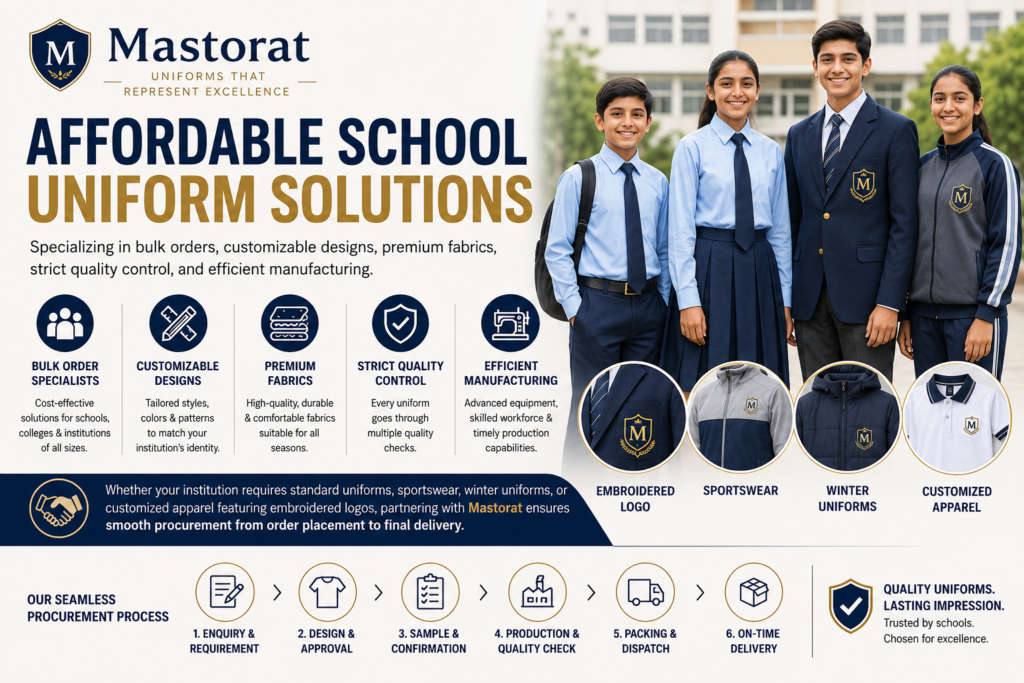
School uniforms play a vital role in creating a sense of identity, discipline, and equality among students. Whether you manage a private school, public educational institution, academy, college, or uniform retail business, choosing the right school uniform supplier is essential for maintaining quality while controlling costs. Bulk purchasing has become the preferred solution for educational organizations looking to ensure consistent uniforms, reliable delivery, and long-term savings.
As educational institutions continue to expand, the demand for affordable school uniforms in large quantities has grown significantly. Schools need suppliers capable of producing thousands of garments without compromising fabric quality, stitching standards, or delivery schedules. A dependable supplier helps administrators streamline procurement while ensuring every student receives comfortable and durable uniforms.
Unikaas specializes in providing affordable school uniform solutions for bulk orders, offering customizable designs, premium fabrics, strict quality control, and efficient manufacturing capabilities. Whether your institution requires standard uniforms, sportswear, winter uniforms, or customized apparel featuring embroidered logos, partnering with an experienced manufacturer ensures smooth procurement from order placement to final delivery.






Why Schools Prefer Bulk Uniform Orders
Educational institutions increasingly purchase uniforms in bulk because it offers numerous financial and operational advantages. Instead of sourcing garments from multiple vendors every academic year, schools benefit from a single trusted manufacturing partner capable of handling ongoing requirements.
Bulk ordering provides:
- Lower cost per garment
- Consistent sizing across batches
- Uniform color matching
- Reliable production timelines
- Simplified inventory management
- Better quality control
- Easier customization options
- Reduced administrative workload
Large-volume manufacturing also allows suppliers to optimize production processes, helping schools receive premium-quality uniforms at competitive wholesale prices.
For schools with hundreds or thousands of students, bulk purchasing eliminates frequent stock shortages while ensuring every student receives the same quality product.
Benefits of Choosing an Affordable School Uniform Supplier
Finding an affordable supplier doesn’t simply mean selecting the lowest price. True affordability combines competitive pricing with dependable quality, durability, and customer service.
Cost Savings Without Sacrificing Quality
A professional uniform manufacturer purchases raw materials in large quantities, allowing production costs to remain low while maintaining fabric quality.
Schools benefit from:
- Wholesale pricing
- Reduced procurement expenses
- Long-term contracts
- Predictable budgeting
- Lower replacement costs
Since uniforms are worn almost every school day, investing in durable garments significantly reduces replacement frequency.
Consistent Product Quality
Consistency is one of the biggest concerns when ordering uniforms annually.
An experienced supplier maintains:
- Identical fabric composition
- Standardized color shades
- Accurate sizing
- Professional stitching
- Reliable finishing
This consistency ensures students maintain a uniform appearance throughout the academic year.
Custom Design Options
Every educational institution has unique branding requirements.
Professional suppliers offer customization such as:
- School logos
- Embroidery
- Printed badges
- Custom colors
- House colors
- Student name tags
- Reflective safety strips
- Sports team branding
Customized uniforms strengthen school identity while enhancing professionalism.
Essential Features of High-Quality School Uniforms
Not every uniform is suitable for daily classroom use. Students require clothing capable of withstanding frequent washing, physical activity, and changing weather conditions.
Comfortable Fabrics
Comfort directly affects student performance.
Popular fabric choices include:
- Cotton blends
- Polyester cotton
- Twill fabric
- Poplin
- Oxford fabric
- Stretch blends
These materials offer breathability while remaining durable enough for everyday wear.
Strong Stitching
Uniform durability depends heavily on stitching quality.
Reliable manufacturers use:
- Double stitching
- Reinforced seams
- Heavy-duty thread
- Secure button attachment
- Durable zippers
These construction methods significantly extend garment lifespan.
Color Fastness
Uniform colors should remain vibrant even after repeated washing.
Professional manufacturers perform testing for:
- Wash resistance
- Sunlight exposure
- Shrinkage
- Color bleeding
- Abrasion resistance
Quality testing reduces complaints from parents while maintaining a professional appearance.
Types of School Uniforms Available for Bulk Orders
Educational institutions often require more than one type of uniform throughout the academic year.
A complete supplier typically manufactures:
Summer Uniforms
Designed using lightweight breathable fabrics, summer uniforms provide comfort during warmer months while maintaining a neat appearance.
Common products include:
- Shirts
- Blouses
- Skirts
- Shorts
- Lightweight trousers
Winter Uniforms
Cold-weather uniforms include:
- Sweaters
- Cardigans
- Hoodies
- Jackets
- Blazers
- Winter trousers
These garments provide warmth without restricting movement.
Sports Uniforms
Physical education uniforms require moisture-managing fabrics capable of supporting active students.
Sports collections usually include:
- T-shirts
- Track suits
- Shorts
- Joggers
- Polo shirts
- Sports jackets
Laboratory Coats
Many schools require laboratory coats for science classes.
Bulk suppliers manufacture:
- White lab coats
- Teacher coats
- Student lab aprons
These garments protect clothing while maintaining safety standards.
Staff Uniforms
Educational institutions frequently order uniforms for:
- Teachers
- Administrative staff
- Receptionists
- Security personnel
- Maintenance staff
- Drivers
A single supplier simplifies procurement by producing uniforms for the entire institution.
Understanding the School Uniform Manufacturing Process
Knowing how uniforms are produced helps buyers evaluate suppliers more effectively.
Professional manufacturing generally follows these stages:
Requirement Analysis
The supplier discusses:
- Student age groups
- Uniform specifications
- School colors
- Fabric preferences
- Quantity requirements
- Delivery schedules
Proper planning minimizes production errors.
Sample Development
Before mass production begins, manufacturers prepare samples for approval.
Schools review:
- Fit
- Fabric
- Stitching
- Color accuracy
- Logo placement
- Accessories
Production begins only after final approval.
Fabric Procurement
Reliable manufacturers source premium-quality fabrics from trusted textile mills.
Incoming materials undergo inspection for:
- Fabric weight
- Shade consistency
- Shrinkage
- Strength
- Defects
Only approved materials enter production.
Pattern Making
Professional pattern makers develop accurate size templates for every age group.
Digital pattern systems improve:
- Measurement consistency
- Fabric utilization
- Production efficiency
- Size grading accuracy
This process ensures every student receives a well-fitting uniform.
Cutting and Sewing
Automated cutting machines improve accuracy while minimizing fabric waste.
Experienced sewing operators assemble garments using standardized production techniques.
How to Choose the Best School Uniform Supplier for Bulk Orders
Selecting the right school uniform supplier goes beyond comparing prices. Schools need a manufacturing partner that can consistently deliver high-quality uniforms, meet deadlines, and support long-term procurement needs. A reliable supplier helps educational institutions maintain a professional image while ensuring students receive comfortable, durable, and well-fitted uniforms.
When evaluating suppliers, consider the following factors:
Manufacturing Experience
Experience matters in uniform production because school apparel has unique requirements. Unlike fashion garments, school uniforms must withstand daily wear, frequent washing, and changing weather conditions.
An experienced supplier understands:
- Age-specific sizing
- School dress code requirements
- Seasonal fabric selection
- Large-scale production management
- Quality assurance processes
Working with a manufacturer that has years of experience reduces production errors and ensures consistent quality across every order.
Production Capacity
Before placing a bulk order, schools should evaluate whether the supplier can handle the required volume.
Ask questions such as:
- How many uniforms can be produced each month?
- Can production increase during admission season?
- What is the average lead time?
- How are urgent orders managed?
A supplier with strong manufacturing capacity can accommodate both planned and emergency orders without compromising quality.
Quality Assurance Standards
Quality control is one of the most important aspects of school uniform manufacturing.
Professional suppliers inspect garments throughout the production process rather than waiting until the final stage.
Typical quality inspections include:
- Fabric inspection
- Cutting accuracy
- Stitching consistency
- Measurement verification
- Logo placement
- Button and zipper testing
- Final garment inspection
- Packaging review
Multiple quality checkpoints help ensure every uniform meets institutional expectations.
Why Fabric Quality Matters for School Uniforms
Students wear school uniforms for several hours every day, making fabric quality essential for comfort, durability, and appearance.
Breathability
Comfortable uniforms improve the overall learning experience. Breathable fabrics help regulate body temperature and reduce discomfort during long school hours.
Suitable fabric options include:
- Cotton blends
- Poly-cotton fabrics
- Lightweight woven materials
- Moisture-managing performance fabrics for sports uniforms
These materials provide comfort while maintaining a neat appearance throughout the school day.
Durability
Parents expect school uniforms to last an entire academic year despite frequent washing and daily use.
Durable fabrics offer:
- Better tear resistance
- Reduced shrinkage
- Improved shape retention
- Long-lasting color
- Minimal pilling
High-quality materials reduce replacement costs for both schools and families.
Easy Maintenance
School uniforms should be easy to wash, dry quickly, and require minimal ironing.
Low-maintenance fabrics help busy parents while ensuring students always have clean, presentable uniforms.
Customization Options for School Uniform Bulk Orders
Every educational institution has its own identity, and customized uniforms help reinforce that identity.
Modern school uniform suppliers offer a wide range of customization services.
Embroidered School Logos
Embroidery remains one of the most popular branding methods because it is durable and professional.
Schools can add logos to:
- Shirts
- Blazers
- Sweaters
- Jackets
- Sportswear
- Caps
Proper embroidery maintains its appearance even after repeated washing.
Printed Designs
Printing is suitable for sports uniforms, event apparel, and activity-based clothing.
Popular printing techniques include:
- Screen printing
- Heat transfer
- Digital printing
These methods allow schools to display slogans, event names, or house team branding.
Personalized Identification
Some institutions request personalized features such as:
- Student names
- Identification numbers
- Class badges
- Department labels
These additions simplify uniform management and reduce the risk of misplaced garments.
Bulk Pricing Advantages for Educational Institutions
One of the biggest reasons schools purchase uniforms in bulk is the opportunity to reduce overall costs.
Wholesale manufacturing provides better pricing because production becomes more efficient as order quantities increase.
Lower Cost Per Unit
As order size grows, manufacturing costs are distributed across a larger number of garments.
This allows schools to benefit from:
- Wholesale fabric purchasing
- Reduced labor costs per item
- Efficient production scheduling
- Lower transportation costs
The result is better value without sacrificing quality.
Long-Term Supply Agreements
Many educational institutions prefer annual or multi-year purchasing agreements.
Long-term partnerships often provide benefits such as:
- Stable pricing
- Priority production
- Reserved manufacturing capacity
- Faster repeat orders
- Consistent fabric availability
These agreements help schools manage budgets more effectively.
Importance of Accurate Sizing in Bulk School Uniform Orders
Sizing consistency is essential when producing uniforms for hundreds or thousands of students.
Professional suppliers develop standardized size charts based on age groups and body measurements.
Size Sampling
Before mass production begins, suppliers usually prepare sample garments for approval.
Schools can verify:
- Sleeve length
- Shirt width
- Trouser length
- Waist measurements
- Skirt fit
- Blazer sizing
Early approval reduces the likelihood of costly alterations after production.
Size Grading
Digital grading systems enable manufacturers to create accurate sizes across multiple age groups.
Benefits include:
- Better fit
- Reduced returns
- Simplified ordering
- Greater student comfort
Consistent sizing also makes repeat orders easier each academic year.
Packaging and Delivery for Large Uniform Orders
Efficient packaging is just as important as manufacturing quality.
Professional suppliers organize uniforms to simplify distribution once they arrive at the school.
Individual Packaging
Many institutions request individually packed garments that include:
- Size labels
- Student information
- Barcode identification
- Garment care instructions
This saves administrative time during uniform distribution.
Bulk Carton Packing
For wholesale buyers, uniforms are carefully packed into export-quality cartons that protect garments during transportation.
Proper packaging helps prevent:
- Moisture damage
- Wrinkles
- Fabric contamination
- Shipping losses
On-Time Delivery
Schools often operate within strict academic calendars, making timely delivery essential.
Reliable suppliers maintain production schedules and logistics planning to ensure uniforms arrive before the start of each academic term.
Common Mistakes Schools Should Avoid When Ordering Uniforms
Bulk purchasing requires careful planning. Avoiding common mistakes can save both time and money.
Choosing Based Only on Price
The cheapest quotation may not provide the best value. Poor-quality fabrics or inconsistent stitching often lead to higher replacement costs.
Instead, evaluate suppliers based on quality, experience, production capacity, and customer support.
Ignoring Sample Approval
Skipping the sample approval stage increases the risk of sizing or design issues.
Always review and approve samples before authorizing full production.
Ordering Without Future Planning
Schools should consider future enrollment growth when placing bulk orders.
Ordering a small reserve stock helps accommodate new admissions during the academic year.
Incomplete Specifications
Clear communication prevents misunderstandings.
Provide detailed information about:
- Fabric type
- Colors
- Logo placement
- Sizes
- Accessories
- Packaging requirements
- Delivery schedule
Well-defined specifications help ensure the finished uniforms match expectations.
Building a Long-Term Partnership with Your Uniform Supplier
A dependable supplier becomes more than a vendor—they become a strategic partner.
Long-term collaboration offers several advantages:
- Consistent product quality
- Faster repeat orders
- Better production planning
- Improved pricing
- Stronger communication
- Reliable after-sales support
By maintaining an ongoing relationship, schools can streamline procurement and ensure students receive high-quality uniforms year after year.
OEM and Private Label School Uniform Manufacturing
Many educational organizations, distributors, and retailers prefer working with an Original Equipment Manufacturer (OEM) that can produce school uniforms under their own brand. OEM and private label manufacturing provide flexibility, consistency, and greater control over branding while eliminating the need to invest in production facilities.
Unikaas offers comprehensive OEM manufacturing solutions designed to meet the needs of schools, wholesalers, uniform retailers, and institutional buyers. From design development to final packaging, every stage is managed with precision to ensure the finished products meet client specifications.
OEM services typically include:
- Custom garment development
- Private label branding
- Custom size charts
- Embroidered or printed logos
- Custom packaging
- Barcode and SKU labeling
- Bulk production
- International shipping support
Private label manufacturing allows schools and distributors to build a recognizable identity while maintaining consistent product quality.
Custom Design Solutions for Educational Institutions
Every school has its own identity, represented through colors, logos, and dress codes. A professional uniform supplier should have the expertise to transform these requirements into practical, attractive, and durable uniforms.
The design process usually includes:
- Consultation with school representatives
- Fabric recommendations
- Color matching
- Prototype development
- Sample approval
- Final production planning
This collaborative approach ensures every uniform reflects the institution’s branding while remaining comfortable for students.
Modern suppliers also accommodate special requests such as:
- House color variations
- Graduation uniforms
- Club apparel
- Event-specific uniforms
- Competition sportswear
- Staff uniforms with department-specific branding
Customization enables schools to create a cohesive and professional appearance across every department.
Exporting School Uniforms to International Markets
The demand for high-quality school uniforms extends beyond local markets. Many educational institutions and distributors around the world source uniforms from experienced manufacturers capable of handling international orders.
Export-ready suppliers understand the complexities of global trade, including documentation, packaging, and logistics.
International bulk orders often include:
- School uniforms
- Sports uniforms
- Blazers
- Sweaters
- Laboratory coats
- Teacher uniforms
- Administrative staff apparel
A reliable export partner ensures products arrive safely while complying with destination country requirements.
Efficient Export Documentation
International shipments require accurate documentation to avoid customs delays.
Professional exporters assist with:
- Commercial invoices
- Packing lists
- Certificates of origin
- Shipping marks
- Export declarations
- Product labeling
Well-prepared documentation helps ensure a smooth import process for buyers.
Global Shipping Support
Bulk uniform suppliers work with trusted logistics partners to deliver orders efficiently.
Shipping methods may include:
- Sea freight
- Air freight
- Express courier services
- Consolidated cargo
Choosing the right transportation method depends on order size, destination, and delivery deadlines.
Sustainable School Uniform Manufacturing
Sustainability has become an important consideration for educational institutions worldwide. Schools increasingly seek suppliers that minimize environmental impact while maintaining product quality.
Responsible manufacturing practices benefit both institutions and the environment.
Eco-Friendly Fabric Options
Many manufacturers now offer sustainable materials, including:
- Organic cotton
- Recycled polyester
- Environmentally responsible blended fabrics
- Low-impact dyes
These materials help reduce resource consumption while maintaining durability.
Reducing Production Waste
Modern production facilities use efficient cutting technologies that maximize fabric utilization and minimize waste.
Additional sustainability initiatives include:
- Fabric recycling programs
- Responsible waste management
- Energy-efficient machinery
- Water conservation processes
Reducing waste not only supports environmental goals but also improves manufacturing efficiency.
Ethical Manufacturing Practices
Schools increasingly value suppliers that maintain ethical working conditions.
Responsible manufacturers prioritize:
- Fair wages
- Safe workplaces
- Skilled workforce development
- Compliance with labor regulations
- Transparent production practices
Ethical manufacturing strengthens trust between suppliers and educational institutions.
Quality Certifications and Compliance
Quality certifications demonstrate a supplier’s commitment to consistent manufacturing standards.
While certification requirements vary by region, professional manufacturers often implement internationally recognized quality management systems.
Quality assurance focuses on:
- Fabric performance
- Stitching durability
- Color consistency
- Size accuracy
- Garment safety
- Production traceability
Schools benefit from suppliers that follow documented quality procedures throughout the manufacturing process.
Regular inspections help ensure uniforms perform well throughout the academic year.
Technology in Modern Uniform Manufacturing
Advancements in garment manufacturing have significantly improved production efficiency and quality.
Leading suppliers use technology throughout the production cycle.
Digital Pattern Development
Computer-aided pattern making improves:
- Size consistency
- Fabric utilization
- Production speed
- Pattern accuracy
Digital systems reduce manual errors and support efficient bulk manufacturing.
Automated Fabric Cutting
Precision cutting equipment ensures every garment component is produced according to approved specifications.
Benefits include:
- Reduced material waste
- Improved consistency
- Faster production
- Better efficiency
Production Tracking
Modern factories often use production management systems that monitor every stage of manufacturing.
This improves:
- Order tracking
- Production planning
- Delivery scheduling
- Inventory management
Technology enables suppliers to complete large-volume orders while maintaining high quality standards.
Why Unikaas Is the Right Choice for Bulk School Uniform Orders
Selecting the right manufacturing partner can significantly impact the success of a school’s uniform program. Unikaas combines industry expertise with modern production capabilities to deliver affordable, durable, and customized school uniforms for institutions of all sizes.
Key advantages of working with Unikaas include:
- Competitive bulk pricing
- Premium-quality fabrics
- Experienced production teams
- Custom design services
- Logo embroidery and printing
- Strict quality inspections
- Flexible order quantities
- Reliable production schedules
- Export-ready packaging
- Dedicated customer support
Whether supplying uniforms for a single institution or managing large-scale distribution projects, Unikaas focuses on delivering consistent quality and dependable service.
By understanding the unique requirements of educational institutions, the company helps schools simplify procurement while ensuring students receive uniforms that are comfortable, durable, and professionally manufactured.
Planning for Future Uniform Requirements
A successful school uniform program requires more than a single purchase. Schools should develop long-term procurement strategies that support enrollment growth and changing requirements.
Forward planning allows institutions to:
- Forecast annual demand
- Maintain consistent sizing records
- Reduce emergency purchases
- Control procurement costs
- Ensure timely deliveries
- Maintain uniform consistency across academic years
Partnering with an experienced supplier like Unikaas provides schools with the confidence that future requirements can be managed efficiently, allowing administrators to focus on education rather than supply chain challenges.
Cost-Saving Strategies for Bulk School Uniform Procurement
Managing school budgets requires careful planning, and uniforms often represent a significant annual expense. While affordability is important, schools should focus on achieving the best overall value rather than simply choosing the lowest price. A strategic procurement plan helps institutions reduce long-term costs while maintaining consistent quality.
One of the most effective ways to lower expenses is by establishing a long-term partnership with a trusted supplier. Instead of sourcing uniforms from different manufacturers every academic year, schools benefit from consistent pricing, reliable production schedules, and standardized product quality.
Additional cost-saving strategies include:
- Ordering in larger quantities to secure wholesale pricing
- Standardizing uniform designs across multiple grade levels
- Selecting durable fabrics that reduce replacement frequency
- Planning purchases before peak production seasons
- Maintaining a reserve inventory for new admissions
- Using standardized size charts for repeat orders
These practices help schools control procurement costs while ensuring students receive durable uniforms that last throughout the academic year.
Planning Seasonal School Uniform Orders
Educational institutions typically require different uniforms for various seasons. Proper planning ensures students receive appropriate clothing before each term begins.
Summer Uniform Production
Summer uniforms should prioritize comfort and breathability while maintaining a professional appearance.
Popular summer garments include:
- Short-sleeve shirts
- Lightweight trousers
- Skirts
- Tunics
- Polo shirts
- Sports T-shirts
Lightweight fabrics improve comfort during warmer months while allowing students to remain active throughout the school day.
Winter Uniform Planning
Winter collections often include:
- Blazers
- Sweaters
- Cardigans
- Hoodies
- Jackets
- Thermal trousers
Ordering winter uniforms well in advance helps schools avoid seasonal production delays and ensures students are prepared for colder weather.
Sports and Activity Uniforms
Many schools require specialized apparel for:
- Physical education classes
- Athletic competitions
- Inter-school tournaments
- Annual sports events
- Outdoor educational activities
Planning these orders alongside standard uniforms simplifies procurement and reduces shipping costs.
Inventory Management for Educational Institutions
Efficient inventory management allows schools to respond quickly to new admissions, size exchanges, and unexpected demand.
Maintaining a small reserve stock of frequently requested sizes can significantly reduce administrative challenges throughout the academic year.
Effective inventory management includes:
- Recording student measurements
- Monitoring available stock
- Tracking uniform distribution
- Forecasting future demand
- Organizing storage by size and garment type
Digital inventory systems further simplify stock management and improve ordering accuracy.
Benefits of Bulk School Uniform Supply for Wholesalers and Retailers
School uniforms are not only purchased directly by educational institutions but also by wholesalers, retailers, and distributors who supply multiple schools within their regions.
Working with an experienced manufacturer offers several commercial advantages.
Consistent Product Availability
Retailers need dependable inventory throughout the year.
A reliable supplier provides:
- Scheduled production
- Repeat manufacturing capability
- Consistent fabric sourcing
- Uniform color matching
- Reliable delivery timelines
This consistency enables retailers to serve schools without interruptions.
Private Label Opportunities
Many wholesalers choose private label manufacturing to establish their own brand identity.
Private label services may include:
- Custom woven labels
- Brand packaging
- Custom hang tags
- Barcode printing
- Retail-ready presentation
This allows distributors to differentiate themselves in competitive markets.
Flexible Order Quantities
Professional manufacturers often support businesses of various sizes by offering flexible minimum order quantities, making it easier for growing retailers to expand their product range without excessive inventory investment.
Managing Large-Scale School Uniform Projects
Supplying uniforms for hundreds or thousands of students requires careful project management.
Experienced suppliers divide production into clearly defined stages to ensure efficiency.
Typical workflow includes:
- Requirement gathering
- Design approval
- Fabric procurement
- Sample development
- Bulk production
- Quality inspections
- Packaging
- Shipping
- Delivery coordination
This structured process minimizes delays while ensuring every garment meets the agreed specifications.
Regular communication between schools and manufacturers further improves project outcomes.
Common Procurement Challenges and Their Solutions
Even well-planned uniform programs can face occasional challenges. Understanding these issues helps schools make informed purchasing decisions.
Challenge: Incorrect Student Measurements
Solution:
Conduct measurement sessions before production begins and verify size charts during sample approval.
Challenge: Delayed Orders
Solution:
Place orders several months before the academic session to allow sufficient production and shipping time.
Challenge: Fabric Inconsistency
Solution:
Choose suppliers with established quality control systems and consistent raw material sourcing.
Challenge: Budget Constraints
Solution:
Negotiate annual supply agreements, prioritize durable fabrics, and forecast future enrollment to optimize purchasing.
Challenge: Last-Minute Admissions
Solution:
Maintain a reserve stock of commonly requested sizes and establish a repeat-order arrangement with the supplier.
Proactive planning significantly reduces procurement risks and improves operational efficiency.
The Importance of Strong Supplier Communication
Successful school uniform projects depend on clear communication between institutions and manufacturers.
Schools should provide detailed information regarding:
- Uniform specifications
- Fabric preferences
- Logo artwork
- Color references
- Size requirements
- Delivery schedule
- Packaging instructions
Likewise, suppliers should provide regular production updates, estimated completion dates, and shipment tracking information.
Transparent communication builds trust and helps avoid misunderstandings during production.
Example of a Successful Bulk Uniform Procurement Process
Consider a school preparing for the upcoming academic year with an enrollment of 1,500 students.
The institution begins planning several months in advance by reviewing previous year’s inventory, updating student enrollment projections, and confirming uniform specifications.
The supplier develops production samples for approval before ordering raw materials in bulk. Once approved, manufacturing proceeds according to a planned schedule with quality inspections conducted throughout production.
After completion, garments are sorted by size, individually packaged, and delivered before the start of the school session.
Because planning began early and communication remained consistent, the school receives high-quality uniforms on time while staying within budget.
This example demonstrates how organized procurement benefits both schools and suppliers.
Bulk Ordering Checklist for Schools
Before placing a large school uniform order, institutions should confirm the following:
- Final student enrollment numbers
- Complete size requirements
- Approved uniform designs
- Fabric specifications
- Color references
- Logo placement details
- Quantity for each garment type
- Packaging preferences
- Delivery timeline
- Budget approval
- Sample approval
- Warranty or replacement policy
- Shipping arrangements
- Contact person for coordination
Using a standardized procurement checklist helps prevent costly mistakes and streamlines the entire ordering process.
Preparing for Long-Term Uniform Success
School uniform procurement is an ongoing process rather than a one-time purchase. Institutions that develop strong relationships with reliable suppliers benefit from consistent quality, efficient ordering, and better financial planning.
By combining thoughtful procurement strategies, accurate forecasting, and dependable manufacturing support, schools can create a uniform program that serves students effectively year after year.
Frequently Asked Questions About Affordable School Uniform Bulk Orders
Educational institutions, distributors, and procurement managers often have similar questions when sourcing school uniforms in large quantities. Understanding these common concerns helps buyers make informed decisions and establish successful long-term partnerships with reliable manufacturers.
What Is Considered a Bulk School Uniform Order?
A bulk order generally refers to purchasing uniforms in large quantities for schools, colleges, academies, educational organizations, or uniform retailers. The exact quantity may vary from one manufacturer to another, but bulk orders are typically large enough to qualify for wholesale pricing and customized production.
Bulk orders often include:
- School shirts
- Trousers
- Skirts
- Blazers
- Sweaters
- Sports uniforms
- Jackets
- Laboratory coats
- Staff uniforms
Ordering multiple garment categories from a single supplier simplifies procurement while ensuring consistent quality.
How Long Does Bulk Uniform Production Take?
Production timelines depend on several factors, including order quantity, garment complexity, customization requirements, fabric availability, and shipping destination.
A professional supplier develops a production schedule after confirming:
- Final artwork
- Approved samples
- Fabric selection
- Quantity breakdown
- Size distribution
Planning orders well before the academic session provides sufficient time for manufacturing, quality inspections, packaging, and transportation.
Early planning also reduces the likelihood of delays during peak production seasons.
Can School Uniforms Be Fully Customized?
Yes. Most experienced manufacturers provide complete customization services to match each institution’s branding requirements.
Customization options commonly include:
- School logo embroidery
- Printed emblems
- Custom colors
- House-specific designs
- Student name labels
- Teacher uniforms
- Sports team branding
- Custom buttons and accessories
These features help schools create a distinctive and professional appearance while maintaining consistency across all uniforms.
What Fabrics Are Best for School Uniforms?
The ideal fabric depends on climate, garment type, and intended use.
Popular choices include:
Cotton Blends
Cotton blends provide comfort, breathability, and durability, making them suitable for everyday classroom uniforms.
Polyester-Cotton Fabrics
These fabrics resist wrinkles, dry quickly, and maintain their appearance after repeated washing.
Performance Fabrics
Sports uniforms often use moisture-managing materials that keep students comfortable during physical activities.
Choosing the right fabric improves comfort while extending the lifespan of each garment.
How Is Uniform Quality Maintained?
Professional manufacturers implement quality control throughout every stage of production.
Quality assurance typically includes:
- Raw material inspection
- Fabric testing
- Pattern verification
- Cutting inspection
- Stitching evaluation
- Measurement checks
- Logo verification
- Final garment inspection
- Packaging review
These procedures help ensure consistent quality across every production batch.
Why Do Schools Prefer Long-Term Manufacturing Partners?
Building a long-term relationship with a trusted supplier offers numerous operational advantages.
Benefits include:
- Consistent sizing
- Stable pricing
- Faster repeat orders
- Reliable production planning
- Improved communication
- Better inventory forecasting
- Consistent fabric quality
Long-term partnerships simplify procurement while reducing administrative workload.
Trends Shaping the Future of School Uniform Manufacturing
The school uniform industry continues to evolve as educational institutions seek better quality, greater sustainability, and improved customization.
Several important trends are shaping the future of uniform production.
Sustainable Manufacturing
Schools increasingly prefer suppliers committed to environmentally responsible production methods.
This includes:
- Eco-friendly fabrics
- Responsible waste management
- Energy-efficient production
- Reduced water consumption
- Sustainable packaging
These initiatives support environmental goals without compromising garment quality.
Digital Manufacturing Technologies
Modern production facilities use advanced technologies to improve efficiency and consistency.
Examples include:
- Computer-aided pattern making
- Automated cutting systems
- Digital production tracking
- Quality monitoring software
Technology enables manufacturers to complete large-volume orders more accurately and efficiently.
Smart Inventory Planning
Educational institutions are increasingly adopting digital inventory systems that simplify uniform distribution and future procurement.
Benefits include:
- Better stock visibility
- Reduced shortages
- Faster reordering
- Improved budgeting
- Accurate demand forecasting
Digital planning improves overall procurement efficiency.
Why Affordability Should Never Compromise Quality
While cost is an important consideration, selecting uniforms based solely on the lowest quotation can result in higher long-term expenses.
Poor-quality uniforms often require frequent replacement because of:
- Fabric fading
- Shrinkage
- Weak stitching
- Color inconsistency
- Button failure
- Premature wear
Investing in durable uniforms reduces replacement costs while improving student satisfaction.
The most affordable solution is one that balances competitive pricing with reliable manufacturing standards.
Why Unikaas Is a Trusted School Uniform Manufacturing Partner
Choosing the right supplier directly influences the success of every school uniform program. Unikaas combines manufacturing expertise, modern production facilities, and strict quality standards to deliver affordable school uniforms for educational institutions of all sizes.
The company focuses on:
- High-quality materials
- Skilled craftsmanship
- Competitive wholesale pricing
- Custom uniform development
- Reliable production schedules
- Comprehensive quality inspections
- Flexible manufacturing capabilities
- Professional customer support
Whether supplying uniforms for a local school, a nationwide educational network, or an international distributor, Unikaas is committed to delivering products that meet both functional and aesthetic expectations.
Its customer-focused approach ensures every order receives careful attention, from initial consultation to final delivery.
Final Thoughts
Selecting an affordable school uniform supplier for bulk orders is a strategic decision that impacts students, parents, teachers, and school administrators alike. The right manufacturing partner provides more than just uniforms—they deliver consistency, reliability, and long-term value.
Schools should prioritize suppliers with proven manufacturing experience, strong quality control systems, flexible customization options, and the ability to meet delivery deadlines. Careful planning, clear communication, and long-term collaboration help create a smooth procurement process while keeping costs under control.
As educational institutions continue to grow, the demand for durable, comfortable, and cost-effective uniforms will remain strong. By partnering with an experienced manufacturer like Unikaas, schools can confidently provide students with uniforms that reflect professionalism, promote school identity, and withstand the demands of daily use.
