
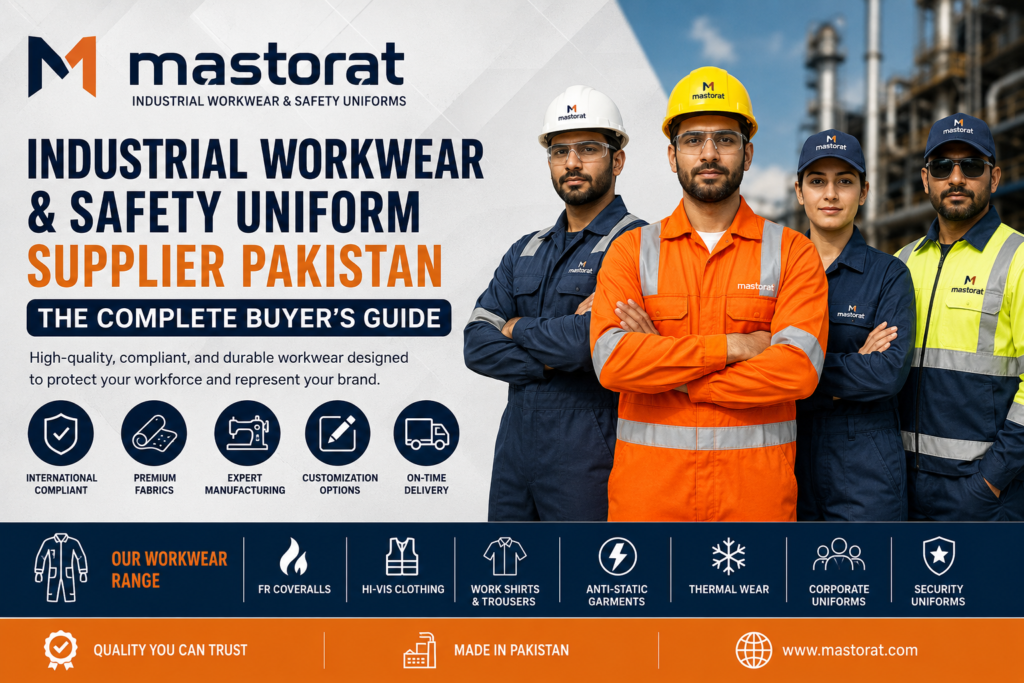
Pakistan has quietly become one of the world’s most trusted sourcing destinations for industrial workwear and safety uniforms. Decades of textile manufacturing expertise, access to raw cotton, competitive labor costs, and a growing base of factories that understand international compliance standards have combined to put Pakistani manufacturers on the shortlist of procurement managers from Europe, North America, the Middle East, and beyond.
If you are a distributor, a facility manager, a safety officer, or a corporate buyer trying to find a reliable industrial workwear and safety uniform supplier in Pakistan, this guide walks you through everything you need to know — from fabric selection and compliance certifications to order quantities, customization, and what separates a serious manufacturer from a middleman reseller.




What Counts as Industrial Workwear and Safety Uniform
Before comparing suppliers, it helps to be precise about what falls under the “industrial workwear” umbrella, because the category is broader than most first-time buyers assume.
Industrial workwear typically includes:
- Coveralls and boiler suits for factory floors, oil and gas sites, and mechanical workshops
- Flame-resistant (FR) clothing for welders, electricians, and petrochemical workers
- High-visibility (hi-vis) jackets and vests for construction, logistics, and roadside crews
- Chemical-resistant and disposable protective suits for cleanroom or hazardous material handling
- Cargo trousers, work shirts, and bib overalls for general labor and maintenance teams
- Corporate uniforms for security guards, hospitality staff, and healthcare workers
- Cold-storage and thermal workwear for cold chain, food processing, and logistics warehouses
- Anti-static garments for electronics assembly and pharmaceutical manufacturing
Each of these categories has its own fabric requirements, stitching techniques, and compliance benchmarks, which is why choosing a supplier that specializes broadly across industrial categories — rather than one that only knows how to cut a basic uniform — makes a measurable difference in the durability and safety performance of the final product.
Why Pakistan Has Become a Preferred Sourcing Hub
A Textile Ecosystem Built Over Generations
Pakistan is among the top cotton-producing countries in the world, and cities like Faisalabad, Karachi, Lahore, and Sialkot have built entire industrial clusters around spinning, weaving, dyeing, and garment stitching. This vertical integration means a workwear manufacturer in Pakistan can often source fabric, thread, zippers, reflective tape, and labels all within a short radius, cutting both lead time and cost compared to manufacturers who import raw materials from multiple countries.
Competitive Manufacturing Costs Without Compromising Quality
Labor and production costs in Pakistan remain significantly lower than in China, Turkey, or Eastern Europe, while skilled stitching labor — particularly in industrial and heavy-duty garment segments — has decades of institutional experience. Buyers frequently find that Pakistani factories can match the stitch quality and durability of higher-cost regions at a materially lower per-unit price, which matters enormously when ordering in bulk for large workforces.
Familiarity with International Compliance Standards
Serious Pakistani manufacturers that export to the EU, UK, Gulf countries, and North America are accustomed to working with international standards such as EN ISO 11611 (welding protective clothing), EN ISO 20471 (high-visibility clothing), EN 1149 (anti-static clothing), and OEKO-TEX certified fabrics. This familiarity is not universal across every factory, so it remains something a buyer should verify directly — but the exposure to export markets over the years has raised the baseline quality bar across the industry.
Flexible Minimum Order Quantities
Unlike some large-scale Southeast Asian manufacturers who only accept container-sized orders, many Pakistani workwear suppliers are structured to accommodate mid-sized and even smaller bulk orders. This flexibility is particularly valuable for distributors testing a new market, corporate buyers with a single facility, or NGOs procuring uniforms for a defined project.
Key Fabrics Used in Industrial Workwear Manufacturing
Fabric choice is arguably the single most important decision in workwear procurement, because it determines comfort, durability, and — in hazardous environments — actual worker safety.
Cotton Drill and Twill
Cotton drill and twill fabrics remain the backbone of general industrial workwear because they are breathable, durable, and relatively inexpensive. A 240–320 GSM cotton twill is common for coveralls and cargo trousers used in warehouses, general manufacturing, and light mechanical work.
Poly-Cotton Blends
Poly-cotton blends (usually 65% polyester, 35% cotton, or similar ratios) are popular where buyers want the durability and easy-care properties of polyester combined with the breathability of cotton. These blends resist shrinking and wrinkling better than pure cotton, making them a common choice for corporate uniforms and hospitality wear.
Flame-Resistant (FR) Fabrics
For welding, oil and gas, and electrical work, FR fabric is non-negotiable. Pakistani manufacturers working in this segment typically use treated cotton or inherently FR fabrics that meet recognized flame-resistance standards. It is critical to ask suppliers for test certificates rather than verbal assurances, since FR treatment quality varies significantly between factories.
Ripstop Nylon and Reinforced Fabrics
Ripstop weaves are used where tear resistance matters most — cargo pockets, knee reinforcement panels, and elbow patches on heavy-duty coveralls. This fabric type extends the working life of a garment in environments with sharp edges, rough surfaces, or frequent kneeling and crawling.
High-Visibility Fabric with Reflective Tape
Hi-vis workwear requires fluorescent orange, yellow, or lime fabric combined with silver reflective tape sewn at regulated widths and placements. Compliance here is not cosmetic — it is directly tied to worker visibility and, in many countries, to legal liability if the garment does not meet the applicable visibility class.
Compliance Standards Every Buyer Should Ask About
A supplier’s willingness to discuss compliance standards openly, and provide documentation on request, is one of the clearest signals of manufacturing maturity.
- EN ISO 20471 — High-visibility clothing classification (Class 1, 2, and 3)
- EN ISO 11611 and EN ISO 11612 — Protective clothing for welding and related processes, and clothing to protect against heat and flame
- EN 1149 — Electrostatic properties for anti-static garments
- EN 388 — Mechanical risk protection, generally relevant for accompanying gloves and gauntlets
- OEKO-TEX Standard 100 — Certification that fabric is free from harmful substances
- ISO 9001 — General quality management certification for the manufacturing facility itself
Buyers should not assume compliance based on a product description alone. Reputable suppliers will share lab test reports, and in many cases allow a third-party inspection agency to verify a sample batch before full production begins.
Customization Options Buyers Should Expect
A capable industrial workwear supplier should offer far more than a fixed catalogue of standard sizes and colors. Customization typically includes:
- Embroidered or printed company branding, including logos, employee names, and department codes
- Custom color combinations to match corporate identity or departmental color-coding systems
- Size range extensions, including plus sizes and petite fits for a genuinely diverse workforce
- Pocket and pouch configurations tailored to the tools specific trades actually carry
- Reflective tape placement adjusted to match regional visibility regulations
- Fabric weight adjustments for climate — lighter fabrics for Gulf and South Asian heat, heavier or insulated options for European winters and cold storage environments
A factory that pushes back with genuine technical questions about your working environment — rather than simply agreeing to every request — is usually a sign of real manufacturing experience rather than a trading company relabeling generic stock.
How to Evaluate a Workwear Supplier Before Placing a Bulk Order
Request a Pre-Production Sample
No serious bulk order should be placed without first receiving and physically testing a sample garment. Check stitching density, seam strength, zipper quality, fabric weight consistency, and how reflective tape is bonded to the fabric (heat-sealed tape tends to outperform simply sewn-on strips in wash durability).
Ask for Factory Audit or Compliance Documents
Request ISO certificates, fabric test reports, and — where relevant — a factory audit report from a recognized inspection body. A supplier that is confident in its operations will not hesitate to share these.
Clarify Lead Times in Writing
Lead times for bulk industrial workwear orders from Pakistan typically range from three to eight weeks depending on order size, fabric availability, and the complexity of customization. Get this in writing, along with penalty or compensation terms for significant delays.
Understand Minimum Order Quantities (MOQs)
MOQs vary widely depending on fabric type, customization complexity, and whether the supplier is manufacturing to stock or producing a bespoke run. Clarify MOQ per size and per color, not just a blanket total, since size-curve requirements can quietly inflate your total order.
Confirm Payment and Shipping Terms
International buyers should clarify Incoterms (FOB, CIF, EXW, etc.), acceptable payment methods, and whether the supplier has experience with your destination country’s customs requirements — particularly important for buyers in the EU, UK, US, and Gulf Cooperation Council countries where labeling and compliance documentation is checked at the border.
Industries That Rely Most on Pakistani Workwear Manufacturing
Oil, Gas, and Energy
FR coveralls, arc-flash protective clothing, and chemical-splash suits for refinery and field workers represent one of the highest-value segments, where compliance documentation is treated as mandatory rather than optional.
Construction and Infrastructure
Hi-vis vests, hard-hat compatible jackets, and reinforced work trousers dominate demand from construction contractors, particularly for large infrastructure projects where uniform standardization across subcontractors is a client requirement.
Manufacturing and Warehousing
General industrial coveralls, anti-static garments for electronics assembly, and standard work shirts and trousers make up the highest-volume category, often ordered in the tens of thousands of units annually by large manufacturing groups.
Healthcare and Hospitality
Scrubs, lab coats, housekeeping uniforms, and front-of-house hospitality wear represent a distinct segment where fabric comfort, easy laundering, and consistent sizing matter more than heavy-duty protection.
Security and Facilities Management
Security guard uniforms, often produced in coordination with badge and epaulette suppliers, and facilities maintenance uniforms round out a category defined by corporate branding consistency across large, dispersed workforces.
Sustainability in Workwear Manufacturing
Corporate buyers, particularly in Europe, increasingly ask about the environmental footprint of their uniform supply chain. Forward-looking Pakistani manufacturers have responded with:
- Water-efficient dyeing processes in updated facilities
- Recycled polyester blends for hi-vis and general workwear fabric
- OEKO-TEX certified dye lots that avoid harmful chemical residues
- Reduced fabric wastage through computerized pattern cutting
Buyers with sustainability reporting obligations should ask suppliers directly about their dyeing process, water treatment practices, and any third-party environmental certifications, since self-reported sustainability claims without documentation carry limited weight in audits.
Common Mistakes Buyers Make When Sourcing Workwear from Pakistan
Choosing price over documented compliance.
The cheapest quote is rarely the cheapest option once garment failure, worker safety incidents, or customs rejection due to missing compliance labeling are factored in.
Skipping the sample stage to save time.
A rushed sourcing timeline that skips physical sample testing is one of the most common reasons bulk orders arrive with inconsistent sizing or substandard stitching.
Not clarifying size charts in writing.
Asian and South Asian sizing conventions can differ meaningfully from US and European sizing. A detailed, garment-specific size chart — not a generic S/M/L label — should be confirmed before cutting begins.
Overlooking after-sales support.
Reordering, exchanging defective units, and getting consistent fabric batches for repeat orders is where long-term supplier relationships either prove their value or fall apart. Ask new suppliers directly how they have handled defect claims in the past.
Frequently Asked Questions
What is the typical minimum order quantity for custom industrial workwear from Pakistan?
This varies by supplier and garment type, but many manufacturers can accommodate orders starting in the low hundreds of units for standard designs, with higher MOQs applying to heavily customized or specialty fabric orders.
How long does a bulk workwear order take to manufacture and ship?
Typical production timelines range from three to eight weeks, with additional time required for international shipping depending on the destination and shipping method chosen.
Can Pakistani manufacturers produce garments to EN and ISO safety standards?
Established manufacturers with export experience can produce to recognized international standards, but buyers should always request test certificates and, where the order value justifies it, arrange independent verification.
Is it possible to get fabric and color samples before committing to a bulk order?
Yes — reputable suppliers routinely provide fabric swatches and pre-production samples, and any supplier unwilling to do so should be treated as a caution flag rather than a minor inconvenience.
Final Thoughts
Sourcing industrial workwear and safety uniforms from Pakistan offers a genuine combination of manufacturing depth, cost competitiveness, and increasing compliance sophistication — but the advantage only materializes when buyers do the due diligence: requesting samples, verifying certifications, clarifying size charts and lead times in writing, and choosing manufacturers rather than resellers wherever the order size justifies it. Buyers who treat supplier selection with the same rigor as any other critical procurement decision consistently report better outcomes — both in garment durability and in the safety of the workers who ultimately wear these uniforms every day.
